


What does the Baghchal board look like?
The Baghchal board is a network of 25 points, arranged five across and five down. Straight lines join every point to its neighbours horizontally and vertically. On top of that, the board draws six diagonals: the two that run corner to corner, and four shorter ones that link the midpoint of each side to the midpoints beside it.
Pieces stand on the points where lines cross. They never sit inside a square. If you are used to chess or draughts, this is the single biggest adjustment.
Print a Bagh Chal board
Download the blank board and print it on one sheet of A4 or US Letter paper. Choose Fit to page in the print dialog. Use four matching coins or stones for the tigers and twenty smaller pieces for the goats.
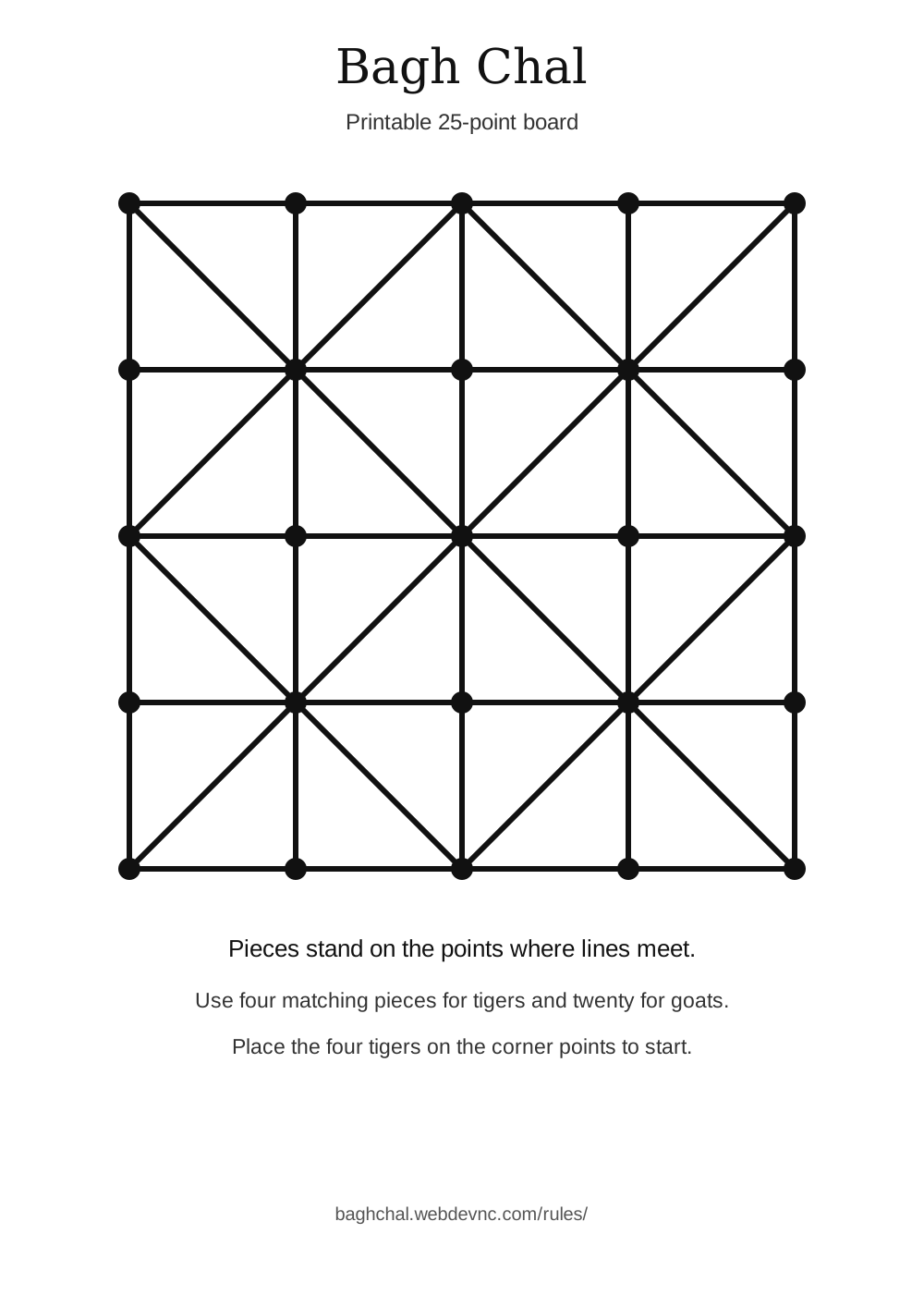
The file uses the same 25 points and connecting lines as the browser game. Place the four tiger pieces on the corners. Keep all goats off the board until the goat player places the first one.
Which lines connect where?
Every point connects orthogonally — up, down, left, right, wherever the edge of the board allows. Diagonals are the exception, and they follow a strict pattern: they exist at alternating points, so the diagonal network touches thirteen of the 25 points and skips the other twelve entirely.
The practical consequence: a piece standing on a diagonal point can leave in up to eight directions. A piece on a non-diagonal point has four at most, and fewer near an edge. The lines form a map of escape routes.
Which points offer the most routes?
The centre and the four inner diagonal points each connect to eight neighbours on an empty board. A tiger on one of those points may have several move and jump directions, depending on the pieces around it.
Corners connect to three neighbours. Other edge points and non-diagonal points offer different route counts. Count the lines from the current point instead of ranking a point without the pieces around it.
Where do the tigers start?
All four tigers begin on the four corner points. The board is empty of goats.
Each corner connects to three neighbouring points. Goats can trap a corner tiger by blocking those routes and occupying the landing point behind each blocking goat. The tiger can also leave a corner while a connected point remains open.
How captures depend on the lines
A tiger's jump has to travel along one continuous line: the tiger, the goat it jumps, and the empty point it lands on all have to sit in a straight row on a line the board actually draws.
This is why a goat on a non-diagonal point next to a tiger is often perfectly safe while the same goat one point over would be lost. Before you place a goat, trace the line through it and check what is on the far side. If that point is empty and a tiger is on the near side, you have just fed the tiger.
Writing a position down
For notes, puzzles, or post-game analysis, the simplest scheme is to number rows one to five from the top and columns one to five from the left, then refer to a point as row-column. The starting tigers stand on 1-1, 1-5, 5-1 and 5-5; the centre is 3-3.
Any consistent scheme works. What matters is that a written position records four things: where every piece stands, whose turn it is, how many goats are still waiting to be placed, and how many have been captured. Leave any of those out and the position is ambiguous.
Other hunt games may use triangular boards, different point counts, or different pieces. See how Baghchal compares with Aadu Puli Attam and other hunt games before applying another game's board or rules.
With the geography settled, the full rules will make a lot more sense, and the strategy pages will start sounding like advice rather than theory.